Say you want to research a topic across the whole of the internet. You'll soon realize that different internet platforms have become like a set of gated buildings with different conversations, with a good number of them treating AI agents like college interns doing a survey and locking them out. This is where /last30days comes in.
What is /last30days?
/last30days is an AI agent skill developed by mvanhorn that automates searching and summarizing topics across multiple siloed platforms all around the internet.
LLMs often use tools to get the latest data from the major platforms and search engines such as Reddit, X, TikTok, Hacker News, and Polymarket. However, conversations and insights from one platform can't be found on others. It is even harder to access all of these platforms through a single LLM service. For example, we couldn't get Claude to natively surface or analyze Reddit results despite our clear prompts to access Reddit. Gemini is tightly integrated with Google's platforms but the same can't be said of other LLM providers. Also, if you're running a cheaper or open-source LLM using the OpenRouter API, it may not have any kind of search capabilities to start with.
Now, if you want to search all of these platforms for a particular topic, and get only a summary or the top relevant content, it's not straightforward to do with an AI. Unless you're using a skill like /last30days, you will spend hours manually searching each platform, going through the content, and synthesizing the relevant bits into a summary.
But once you set up /last30days, your AI can use it to search 15+ platforms and score the content across all of them using likes, upvotes, and even real money (Polymarket bets). At the time of writing, the /last30days skill GitHub repository has been trending with over 54k stars.
In this article, you'll learn about this skill.
TL;DR
- /last30days is a skill/plugin for AI agents that enables them to search for anything across 15+ platforms (Reddit, X, YouTube, TikTok, HN, Polymarket, GitHub, arXiv, Techmeme, and more) and prioritize results by social signals (upvotes, likes, etc.) instead of editorialized content
- /last30days can search all these platforms in parallel for a given topic and cluster together relevant results even if they're from different platforms. It can synthesize one brief to give you all the latest information.
- It's agent-native (supports Claude Code, Codex, Gemini CLI, etc., with 50+ Agent Skills hosts in total), open source with over 54k stars. Some platforms work with zero configuration.
- For developers who need a managed solution with proxy rotation, JS rendering, etc., ScrapingBee offers a cloud-based alternative with scrapers for several platforms under one subscription.
The scattered research problem: Why manual multi-platform search doesn't scale
Real conversations are scattered
For any given topic, information is scattered across different platforms. If you want recommendations about a new city or country before traveling there, a Reddit post gives you genuine suggestions, backed up by upvotes. The latest opinions and takes by prominent figures are found on X. Product reviews with real depth are best on YouTube. Culture signals come from TikTok (or from HN for developers/AI). Polymarket shows the opinions people are putting their money on. All of these platforms are disconnected from each other and often have restrictive search APIs. No single platform has the full picture.
LLMs don't have access
The companies that make LLMs and those that own the platforms where the conversations actually happen are often very different from each other. Google, X, and Meta are just a few exceptions, and even they don't have access to all the platforms. It's been difficult for LLM makers to work with platforms to directly integrate the two. Reddit pages can't be read by Claude natively. The X API is paywalled. Finally, if you're running a self-hosted LLM in your garage, you're stuck with only its training data, which is months out of date.
Google aggregates editors, not people
Google has its own ranking algorithm that is ever-evolving and constantly gamed by SEO folks. However, it does not consider metrics such as likes or upvotes. A Reddit thread with 2,000 upvotes may not rank above an SEO spam article expressing only a single editor's opinions. In a new city, you'd probably want to eat at a restaurant with 20,000 reviews on Google Maps over something suggested by one blogger or influencer.
Manual search is slow
Despite the powerful AIs available in 2026, it seems like the only way to aggregate and research a topic across all platforms is to do it manually. This can take an hour or two for an in-depth analysis. Having 100 tabs open for research isn't a thing of the past yet. And it's not just about time — there is also the cognitive overload of processing so much information across a dozen platforms just to filter a few relevant pieces and get an accurate overview.
Architecture & philosophy
An AI agent skill, not a web app
The /last30days skill functions as an AI skill/MCP server/plugin for various apps and tools, giving uniform search capabilities to all of these. It works with popular coding agents such as Claude Code, Codex, and Gemini CLI, free frameworks such as OpenClaw, and even the claude.ai website. It enables AIs running on all of these applications to do any task or answer any question based on the latest available information.
People-scored search
Search engines typically use PageRank and other opaque algorithms to rank content, and often surface editorial content rather than what is backed by real people's experiences and numbers. With /last30days, people-backed content is prioritized, giving higher weight to likes, upvotes, and even how much money people have put on it.
Multi-platform bridge
The data points on various platforms live in their own silos, unaggregated due to indexing limitations, paywalls, and licensing terms. /last30days bundles connectors for various platforms into one skill, so you can search 15+ platforms from TikTok to HN using your favorite AI app.
Zero-config start, optional additions
/last30days is built to make setup as easy as possible. Upon installing, you can immediately search Reddit, HN, GitHub, and Polymarket. On the first run, you can also use the setup wizard to quickly configure YouTube, TikTok, Techmeme, arXiv, and more.
Open-source and runs locally
The /last30days skill is open source and runs locally (unless you're running the whole thing on the web like with claude.ai). This also enables the community to add coverage for new sources.
Sources: How each platform informs your AI
The /last30days skill supports various sources; here is a list of those sources and a quick word on why each might be relevant to your research.
| Source | Why use it |
|---|---|
| Unfiltered takes backed by upvote counts, not always ranked by search engines | |
| X (formerly Twitter) | Hot takes and the latest posts by experts, celebrities, leaders. Direct from the horse's mouth. |
| YouTube | Deep-dives and detailed reviews, with searchable transcripts to get just the highlights |
| TikTok | Highly engaging content with millions of views/likes that may not be picked up by search engines |
| Instagram Reels | The influencer perspective, again backed by the likes for the visual signal |
| Hacker News | Arguments and likes from where all the developers hang out |
| Polymarket | Opinions might be easy to throw around, but money isn't. This gives signals of what people are putting their money on |
| GitHub | Where the code gets written. Search engines don't surface projects based on stars or the discussions around them |
| Digg | Curated story clusters from the AI world |
| arXiv | Access to the latest research from the scientific world without steep paywalls |
| Techmeme | The latest editorialized tech news when you actually need some editorial quality |
| Posts and articles to give you signals from the professional world | |
| StockTwits | Insights from the social layer of trading that you won't find just from number crunching market data |
| Threads | Like X/Twitter but an entirely different crowd |
| A visual discovery layer that is already curated | |
| Bluesky | Another X/Twitter analogue with a crowd that seems to love decentralized social media |
| Perplexity | Access to raw search data and research |
| Web | Web pages including blogs, product pages, and so on. Used as necessary. |
How it works: From query to synthesis
Here's a brief step-wise breakdown of how /last30days works as per the GitHub README:
- The query starts with a search term that a user types in. It could be any topic: a person, product, company, an X vs. Y comparison.
- Based on the query, the AI agent resolves the suitable people and content. It figures out which X handles, GitHub repositories, YouTube channels, or other sources would be relevant. Take "Lionel Messi", for example: it might search Google for a bio, YouTube for his latest interviews, and X for the latest posts from @TeamMessi.
- Once it figures out what sources to search, it searches multiple sources in parallel. It uses multiple queries for each source (multi-query expansion). It scores results by engagement, freshness, and relevance.
- It can search deeply, covering Reddit comments with upvotes, TikTok captions, and so on. It goes beyond just the titles and links.
- It then merges stories that are distributed across multiple platforms. A music festival that was announced on Reddit and discussed on X will show up as a single cluster with all the context, including even ticket price updates from TikTok.
- Synthesis: Once it has all the sources and merged clusters, the AI agent can give you a single brief with just what you need to know about the topic, with necessary citations so you can cross-verify when needed.
- A context-loaded chat: Once your AI agent has all the context it needs about the topic, it can be very effective and much more accurate when you chat with it.
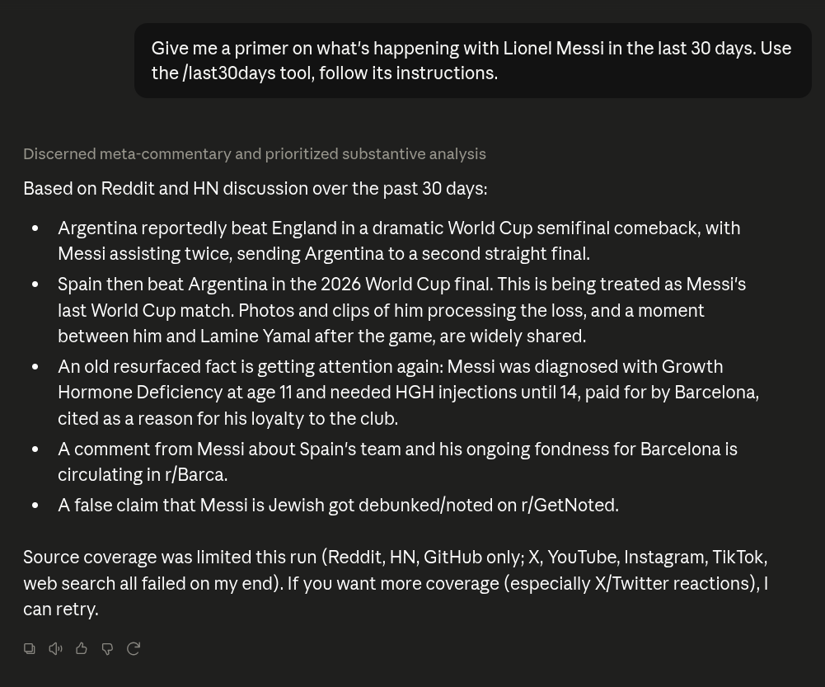
The following image shows our chat asking about Lionel Messi straight after installing /last30days on Claude Desktop. Note that this run is straight out of the box and covers only the zero-config sources. The rest weren't activated before the run.
Real use cases: What people actually use it for
The /last30days skill offers a wide variety of use cases that involve research across multiple sources. Some of these include:
- Quick pre-meeting preparation: Remember that scene in The Avengers where Tony Stark became an expert in Thermonuclear Astrophysics overnight before a meeting? It doesn't take a genius to do that now. You can get a summary of regular search results, posts, YouTube video essays, and the latest research (arXiv) from that field in one place.
- Analyze hiring signals: Want to guess what your competitors might be up to?
/last30days ACME Corporation --hiring-signalswill find which roles the company is currently hiring for, analyze them, and based on the active job titles give you a summary of where the company's focus is shifting to right now. - Discover topics before they start trending: So you're a builder looking to surf the latest trend wave? An open-ended query like
/last30days what's exploding in AI agentswill pick up the latest discussions from HN, Digg, Reddit, X, etc., and give you some fresh and unique perspectives. - Keeping up:
/last30days Kardashianswill search the news, Reddit, TikTok, X, and Polymarket to actually help you keep up with the Kardashians. - Tool comparison: Overwhelmed and confused by so many new tools going around?
/last30days OpenClaw vs Hermes vs Paperclipwill give you a real-time comparison based on everything on these projects' GitHub repos, including documented features, star counts, issues, and so on. - Current affairs: Following the news closely can be addictive and also give you anxiety.
/last30days Iran vs USAcan give you a brief, sensible but non-sensational summary about the conflict and its consequences, such as rising oil prices. You don't need to open Google, go to the news section, sort by date, and go through each article. - Pre-travel sanity checks: Planning your summer vacation with the family?
/last30days Universal Epic Universewill tell you whether the place is currently operating, the status of planned expansions, typical wait times, and what the locals think, so you can prepare accordingly. - To quickly learn something: At the pace the AI ecosystem is moving, any guide or tutorial can get outdated in weeks if not days. But /last30days can write relevant guides for you on demand. For example,
/last30days Nano Banana Pro Promptingwill give you a primer on how to use this tool grounded in the latest updates.
Key features of /last30days
Zero-config wherever possible
Reddit, HN, Polymarket, and GitHub work straight out of the box as soon as you install the skill.
Setup wizard for easy configuration
On the first run of the skill, a setup wizard fires up to help you configure X, YouTube, arXiv, TikTok, Techmeme, and other sources. Some sources are free and some might need API keys to function optimally.
Native integrations for multiple agent frameworks
Though the project recommends using it with Claude Code, it also natively integrates with Codex, Cursor, Copilot, Gemini CLI, and basically any of the 50+ Agent Skills hosts.
Comments coverage
The search covers comments by default across various platforms, such as Instagram, Reddit, and YouTube. This is hard to come by on typical search engines.
Cross-source clustering
Discussions, posts, and news about a specific topic from across different sources are automatically clustered into one unit so you can easily process it.
Sharing via HTML
The skill can generate self-contained HTML briefs that can be shared with anyone and viewed easily in just a web browser.
Continuous trend monitoring
You can use the bundled watchlist script for scheduled runs, or a briefing script to get periodic digests.
/last30days vs. managed solutions
The DIY research trade-off
The /last30days skill offers a way to perform research and synthesis across multiple platforms, and gives you total control over how you set up each source without any intermediary services involved. However, you have to manage the whole thing yourself, including:
- API keys, separately procured and separately billed (if needed) for each platform (X, Perplexity, Instagram, etc.)
- Browser cookies and auth for platforms like X
- Varying rate limits on each platform
- Data format differences across the 15+ platforms
- Proxy rotation and bypassing anti-bot defenses beyond free access limits
- Lack of structured formats for the synthesized result
This might be a lot to set up and manage by yourself, because it is not just technical work but also the ongoing maintenance of billing accounts with multiple platforms.
When a managed solution (like ScrapingBee) makes more sense
While the /last30days skill gives your AI agent the instructions and tools to pull in the latest content from across various platforms on the internet, ScrapingBee solves the data-access half of that problem as a fully managed cloud service. It can be used simply via an API, an MCP server, or even a CLI. With /last30days, you have to set up each source manually, but ScrapingBee provides prebuilt APIs and scrapers for multiple search engines (e.g. Google and Bing), social media platforms (e.g. TikTok), and even Polymarket. The best part is you get access to all of this through one platform under one subscription plan and one bill to pay.
Further, ScrapingBee also handles proxy rotation, running headless browsers, and bypassing anti-bot defenses automatically, so you don't have to worry about setting this up on your local system, with or without the /last30days skill. ScrapingBee also handles scaling, so as your research operation grows, you don't need to worry about getting additional infrastructure to run your search pipelines. Like /last30days, the ScrapingBee API can also provide real-time data from various sources, which can be synthesized by your AI agents.
Conclusion
For developers who need more than research synthesis
The /last30days skill presents an innovative approach to researching any given topic across the internet using AI agents. It synthesizes information by searching 15+ platforms that each have different types of content and perspectives. Some sources work straight out of the box while some need a minimal configuration step. Unlike popular search engines, it gives more weight to the people behind the content and to social validation, using metrics such as likes, upvotes, and even money bets by real people.
While this approach gives deep control with the whole search stack running locally, it can get cumbersome to set up and manage multiple source connectors and APIs separately. For those who'd like to provide their AI agents with real-time updates for research without worrying too much about the setup, ScrapingBee offers a managed alternative.
With multiple scrapers and data sources under one subscription, it also handles all the technical challenges of scraping on its end. You can try this out with 1,000 free credits.
Next steps & resources
/last30days
- Read about and install /last30days: https://github.com/mvanhorn/last30days-skill
ScrapingBee