When you are searching for the best stock market APIs, you are likely looking for a balance between speed, data depth, and cost-effectiveness. Whether you need real-time data for a high-frequency trading bot, historical datasets for backtesting, or seamless trading integrations, the market in 2026 offers a variety of specialized tools.
In this guide, I will take a developer-first look at the top contenders, comparing traditional financial feeds with alternative scraping approaches to help you build robust finance-driven applications.
Quick Answer
If you are in a hurry, here is how the top stock market data APIs stack up for different use cases:
- ScrapingBee: Best web scraping API for custom workflows where official APIs are restricted or too expensive.
- Alpha Vantage: The best stock data api for startups and individual developers needing a solid free tier and standard indicators.
- QuoteMedia: Best for enterprise-grade, best real-time stock data API needs with high compliance standards.
- Bloomberg API: The institutional standard for professional firms where cost is not a budget constraint.
| Tool | Best For | Pros / Cons | Pricing |
|---|---|---|---|
| ScrapingBee | Custom scraping and bypass | + Bypasses anti-bots; - Not parsed JSON response. | From $49/mo |
| Alpha Vantage | Startups and Research | + Great free tier; - Strict rate limits | From $100+/mo |
| QuoteMedia | Enterprise apps | + High reliability; - Complex licensing | Custom enterprise |
| Bloomberg | Institutional trading | + Most authoritative; - Extremely expensive | ~$2,000+/mo |
Best Stock Market APIs
Choosing the best stock APIs requires evaluating data quality, latency, global coverage, and how easily they fit into your stack. The list below features providers ranked from most to least viable.
1. ScrapingBee - For Custom Stock Data Retrieval
Sometimes, an official stock API simply does not provide the specific stock market data you need. I have found that using our solution is the most flexible alternative for these edge cases.
As a specialized financial data API, it handles headless browsers and proxy rotation automatically. This is vital for financial data extraction from JavaScript-heavy sites like Google Finance. ScrapingBee can also bypass a sophisticated anti-bot system created to block standard scripts. The best part is that we prioritize responsible scraping and legal compliance (SOC2 & GDPR) so you can build with peace of mind.
- Best for: Custom workflows where official APIs are restricted, missing niche data, or cost-prohibitive.
- Pros: Bypasses advanced anti-bot detection; handles JavaScript rendering; global proxy rotation.
- Cons: Might be an overkill for ad-hoc requests.
- Pricing: Free tier starts at 1000 free credits. Freelance plan starts at $49/month for 250,000 API credits. Larger plans (Startup/Business) range from $99 to $249+ per month.
2. Alpha Vantage: Open Data-Friendly API
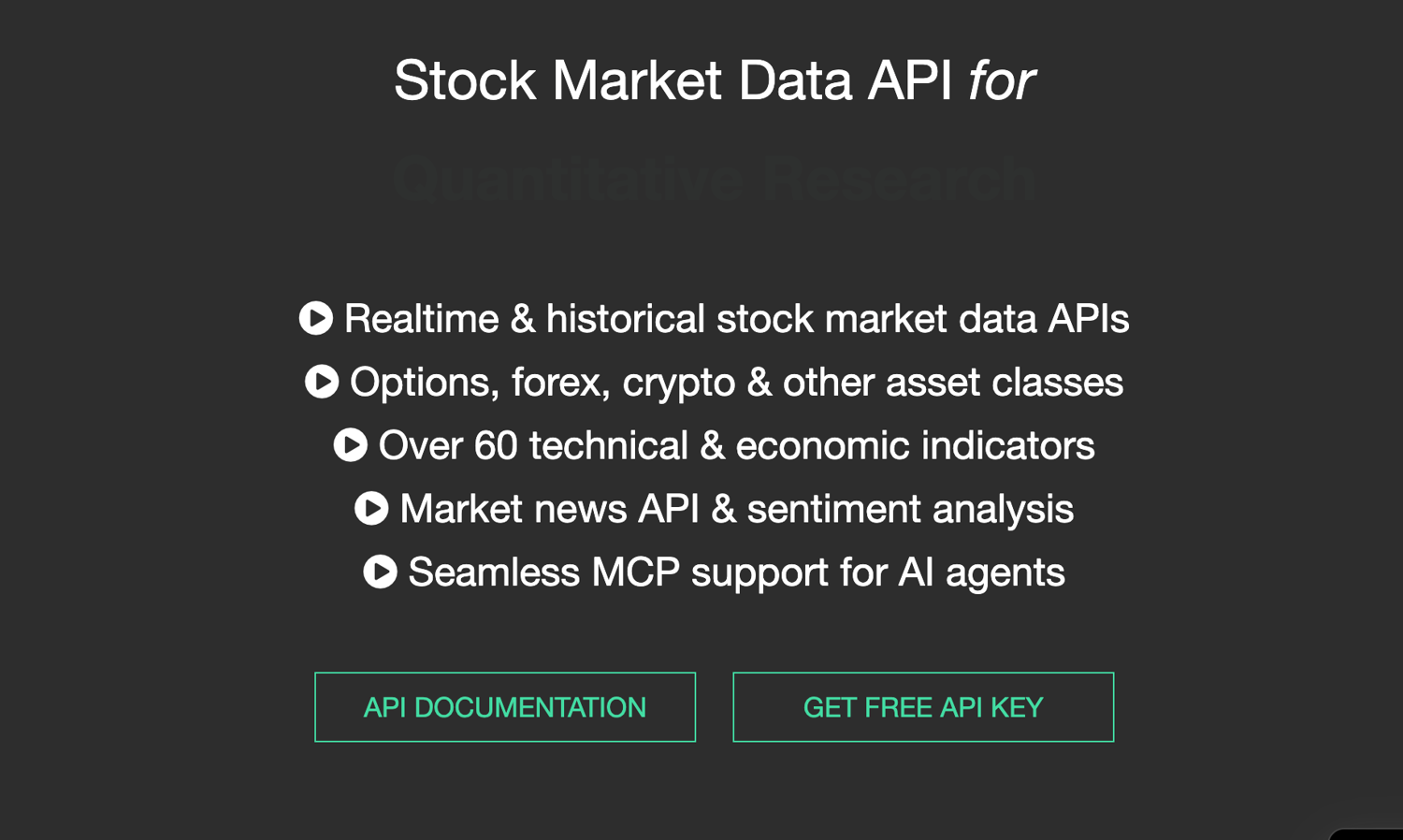
Alpha Vantage remains a top financial data API because of its accessibility. It is likely the best stock data API for those who need historical data and technical indicators without an immediate monthly commitment.
- Best for: Academic research and early-stage MVP development.
- Pros: Excellent documentation and wide language support.
- Cons: The free tier has strict rate limits that can break a real-time app if not managed carefully.
- Pricing: Free for basic use. Premium tiers start at $49.99/month for 75 requests/minute, scaling up to $249+/month for higher throughput.
3. QuoteMedia: Enterprise-Grade Data
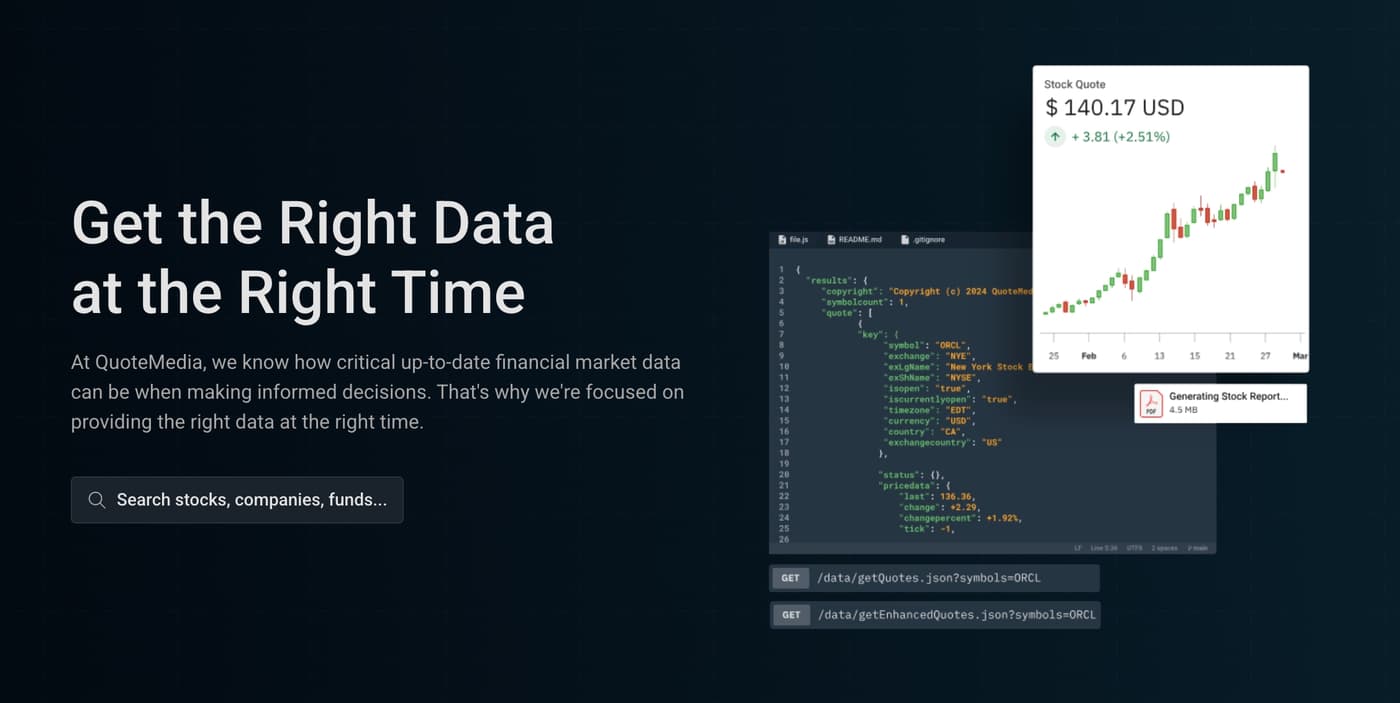
When you need a stock market API that a bank would trust, QuoteMedia is a prime candidate. It provides the best stock market data API experience for professional-grade dashboards.
- Best for: Brokerages and high-traffic financial news portals.
- Pros: Institutional-grade reliability and massive exchange coverage.
- Cons: Pricing and integration are geared toward established companies rather than solo hobbyists.
- Pricing: Generally, custom enterprise pricing. However, individual research tools start around $10–$50/month, while professional exchange feed access typically starts at several hundred dollars per month plus exchange-specific fees.
4. Bloomberg API: Institutional Standard
The Bloomberg API is the best API for stock data if you are operating at the highest levels of finance. It relies on the massive Bloomberg Terminal ecosystem.
- Best for: Hedge funds and institutional asset managers.
- Pros: Unmatched authority, trust, and depth of financial data APIs.
- Cons: Significant cost barriers and walled garden requirements.
- Pricing: Requires a Bloomberg Terminal subscription, which is approximately $25,000–$30,000 per year (roughly $2,500/month). Specific enterprise data licenses for B-PIPE can cost significantly more.
What Is a Stock Market Data API?
Let's quickly look through the basics: a stock market data API is a set of protocols that allows your application to talk to a financial data provider. Most modern services use REST for on-demand data and WebSockets for real-time streaming.
These APIs typically return JSON responses containing common endpoints like quotes, OHLC (Open, High, Low, Close), and fundamentals.
What Makes a Stock Market API Worth Using?
When evaluating the best stock trading API or best real-time stock data API, a specific framework helps cut through the noise:
Real-Time and Historical Data
Does the API offer millisecond-level updates, or is there a 15-minute delay? For backtesting, check if they provide adjusted historical data that accounts for dividends and stock splits.
Asset Class and Exchange Access
A great stock API should cover more than just the NYSE. Look for access to international exchanges, ETFs, and even crypto if your app is multi-asset.
Developer Experience and Languages
Clean documentation and SDKs for Python, Node.js, or Go are essential. A well-designed API should take very little time to return a first response.
Reliability, Latency, and SLAs
For trading apps, downtime equals lost money. Check the provider's uptime history and if they offer a Service Level Agreement (SLA).
How to Choose the Right Tool?
The best API for stock market data depends entirely on your specific project:
- For trading apps: Prioritize low latency and WebSocket support.
- For analytics dashboards: Focus on deep historical stock market data and fundamentals.
- For custom scraping workflows: When you need to extract data from a specific page layout or a site without an API, and when how to scrape stock prices becomes the primary question.
Where Can You Get Stock Market Data From?
Data originates at the exchanges, but most developers get it through aggregators or broker APIs. However, public finance websites are also a massive source of financial data.
If you're looking for niche data, you might even use a Stockx data scraper to track alternative asset trends. Always ensure your stock market data APIs usage complies with the source's terms of service.
Automation and Notifications
Modern stock market API setups are rarely static. You can integrate a stock API into:
- Slack/Discord: For sending stock price updates to Slack when a price hits a certain threshold.
- Trading Bots: To execute trades automatically based on technical indicators.
- Data Pipelines: Feeding raw data into BigQuery or Snowflake for long-term analysis.
Ready to Try a Flexible Stock Data Solution?
If you find that traditional financial data API providers are too restrictive or lack the specific data you need, ScrapingBee can fill the gap. It offers the scalability and automation needed to turn any finance website into your own private stock market data feed.
Sign up today and get your first credits for free to start building.
Best Stock Market APIs FAQs
Is there a free real-time stock API?
Most free best stock market APIs have a 15-minute delay. Truly real-time data usually requires a paid subscription due to exchange licensing fees.
Which brokerage has the best API for trading?
Brokers like Alpaca or Interactive Brokers are frequently cited for having robust stock market APIs for automated execution.
Is Yahoo Finance a reliable stock data source?
Yahoo Finance is excellent for research, but its official API support has been inconsistent. Many developers prefer using a Yahoo! stock scraper to get results more reliably.
Is Google Finance good for financial data extraction?
It is great for clean data, but it lacks a formal API for developers. You will need to learn how to scrape Google Finance using tools that can handle dynamic content.

Jakub is a Senior Content Manager at ScrapingBee, a T-shaped content marketer deeply rooted in the IT and SaaS industry.