Most modern websites load content dynamically. React, Angular, and Vue applications don't serve finished HTML, they render it in the browser after JavaScript executes. Traditional scrapers that fetch raw HTML miss entire pages of data. Finding the best JavaScript web scraper means finding a tool that can execute JavaScript, wait for content to load, and return the rendered DOM.
This guide compares the leading options to help you identify which one fits your stack and build best web scraping JavaScript workflows on a reliable web scraping API foundation.
Quick Answer: What's the Best API for JavaScript-Rendered Web Pages?
The best API for JavaScript scraping is one that runs a headless browser, rotates proxies, and bypasses anti-bot detection, without you managing any of that infrastructure. Among the best JavaScript web scraping solutions available today, ScrapingBee stands out for its reliability and simplicity: a single REST API call that returns fully rendered HTML or structured JSON.
Shortlist - Top JavaScript Web Scraping APIs
Here is a comparison of the best web scraping with JavaScript tools in 2026. Use it to quickly identify which best JavaScript web scraping solutions match your technical requirements.
| Tool | JS Rendering | Proxy Rotation | CAPTCHA Bypass | Scalability | Dev Experience | Ideal Use Case |
|---|---|---|---|---|---|---|
| ScrapingBee | Yes | Yes | Yes | High | Excellent | React/SPA scraping, eCommerce |
| Oxylabs | Yes | Yes | Yes | Enterprise | Good | Large-scale enterprise data |
| ScrapingAnt | Yes | Yes | Yes | Medium | Good | Lightweight API integration |
| ScraperAPI | Yes | Yes | Partial | High | Good | Automation-heavy pipelines |
| Bright Data | Yes | Yes | Yes | Enterprise | Moderate | Enterprise + compliance-heavy |
| Scrapingdog | Yes | Yes | Yes | Medium | Good | Budget-conscious projects |
| Apify | Yes | Yes | Partial | High | Excellent | Custom automation workflows |
| Decodo | Yes | Yes | Partial | High | Good | Proxy-first infrastructure |
| Zenscrape | Yes | Yes | Yes | Medium | Good | Simple JS scraping tasks |
| WebScrapingAPI | Yes | Yes | Yes | Medium | Good | Fast setup, drop-in API |
Top Scrapers for JavaScript Sites
Selection criteria for these tools include rendering accuracy, infrastructure management overhead, anti-bot reliability, and performance under sustained load.
1. ScrapingBee
ScrapingBee is a web scraping API designed specifically for dynamic sites. It manages headless Chrome instances and rotates proxies automatically to navigate anti-bot barriers without manual configuration. The JavaScript scraper API supports custom execution scenarios, such as clicking buttons, filling forms, and waiting for specific elements before extracting data.
At ScrapingBee, we focus on maintaining high success rates on React-based SPAs and eCommerce listings with deferred content loading. It serves as a production-grade integration for teams that want to avoid the DevOps overhead of maintaining a browser fleet. Because JavaScript rendering requires more resources than plain HTTP requests, we provide tools to help profile target pages and keep credit consumption predictable.
Pricing models: Freelance ($49/month), Startup ($99), Business ($249), Business+ ($599+). Free trial: 1,000 credits.
2. Oxylabs
Oxylabs is enterprise-grade proxy and scraping infrastructure with a dedicated Web Scraper API that handles JavaScript rendering at scale. It stands out on concurrency and geographic targeting, built for organizations running thousands of simultaneous requests across multiple regions. GDPR compliance documentation is formal and published.
Pricing reflects the enterprise positioning, not the right tool for solo developers or small teams, but a serious option for large-scale data collection with strict compliance requirements.
Pricing model: JavaScript rendering costs more per result. Web Scraper API starts at $49/month (~$1.60 per 1K results), residential proxies from $2.5/GB.
3. ScrapingAnt
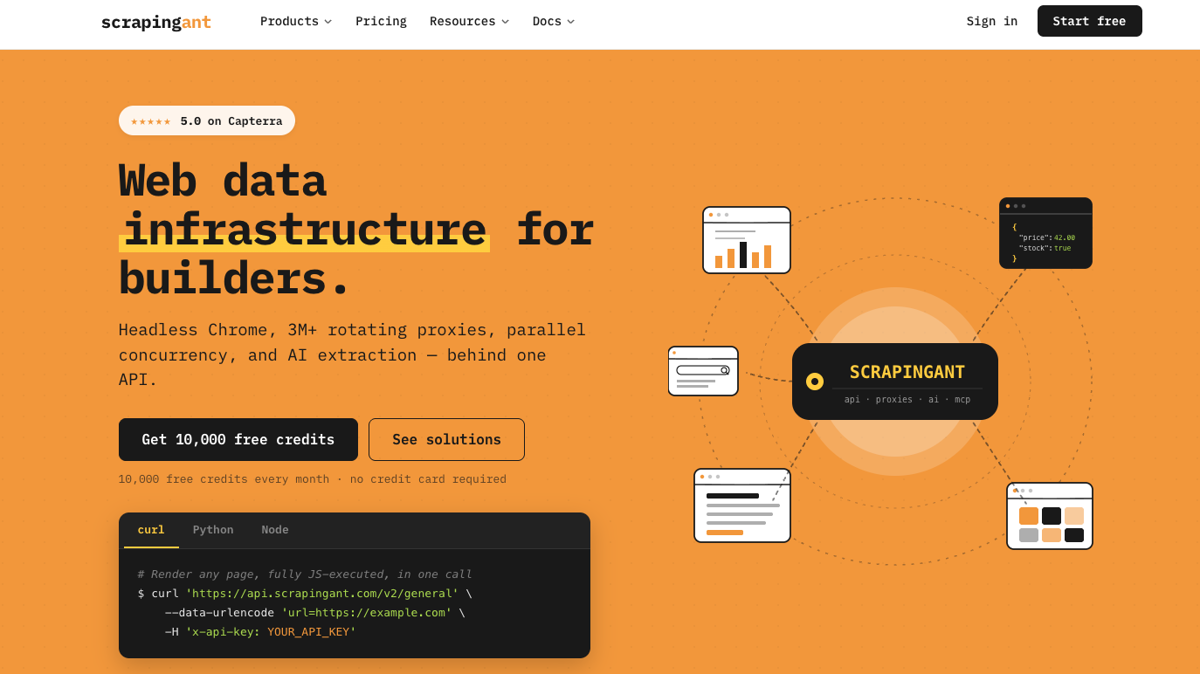
ScrapingAnt uses a lightweight approach, offering headless browser rendering behind a clean REST API with proxy rotation and CAPTCHA handling included. Integration is designed to be straightforward with developer-friendly documentation.
The service is effective for standard JavaScript-rendered pages, such as React applications and content hidden behind scrolls. It is a suitable fit for mid-complexity scraping tasks where an easy-to-deploy API is needed without enterprise-level overhead.
Pricing model: Enthusiast ($19/month), Startup ($49), Business ($249), Business Pro ($599), Custom ($699+). Free trial: 10,000 credits.
4. ScraperAPI
ScraperAPI focuses on proxy rotation and automation-friendly infrastructure. It handles JavaScript rendering via a simple REST interface, making it well-suited for data engineering teams running high-volume pipelines. While success rates on mid-difficulty targets are consistent, it offers partial CAPTCHA solving, meaning highly protected sites may require additional configuration.
Pricing model: Hobby ($49/month), Startup ($149), Business ($299), Scaling ($475), Professional ($975). Free trial: 5,000 credits.
5. Bright Data
Bright Data operates the largest proxy network in the market and offers enterprise scraping tools including Web Unlocker, designed to bypass sophisticated anti-bot systems. JS rendering is strong and geographic coverage for region-specific targets is unmatched. The platform publishes formal GDPR compliance frameworks, making it a fit for compliance-heavy environments.
Setup complexity and pricing reflect its enterprise positioning. It's reliable at scale with documented compliance, but not suited for quick prototyping or small teams.
Pricing model: Free Tier (5K records/mo), PAYG ($1.5/1K records), Scale ($499), Enterprise (Custom). Free trial: 5,000 credits.
6. Scrapingdog
Scrapingdog is a cost-effective option that covers essential requirements: JavaScript rendering, proxy rotation, and CAPTCHA handling. It is effective for standard JavaScript-rendered pages, though high-security targets utilizing sophisticated anti-bot defenses can impact success rates. It delivers solid value for budget-conscious developers or startups prototyping data pipelines.
Pricing model: Starts from Lite ($40/month) and scales up to Nova Pro ($30,000/month).
7. Apify
Apify is a full automation platform built around Actors: modular, deployable scraping and automation scripts you run in the cloud. The Apify Store offers pre-built Actors for common targets including LinkedIn, Reddit, TikTok, and Amazon, which cuts setup time significantly. It supports Playwright, Puppeteer, Scrapy, and Crawlee.
Rated well on G2 for versatility and developer experience, it's the best choice when scraping overlaps with broader automation workflows. Teams that want a simpler plug-and-play REST API will find ScrapingBee faster to get started.
Pricing model: Free ($5 credits), Starter ($29/month), Scale ($199), Business ($999). Free trial: $5 monthly credits.
8. Decodo
Decodo provides proxy infrastructure and scraping APIs with native JavaScript rendering support. Its residential, mobile, datacenter, and ISP proxy network offers strong global coverage.
The service suits both teams who want proxy infrastructure directly and those who want a full scraping API stack, with standalone offerings covering web scraping, SERP, eCommerce, and social media extraction.
Pricing model: Free plan available, then scales to $19/month, $49/month, and $99/month. Custom pricing is available.
9. Zenscrape
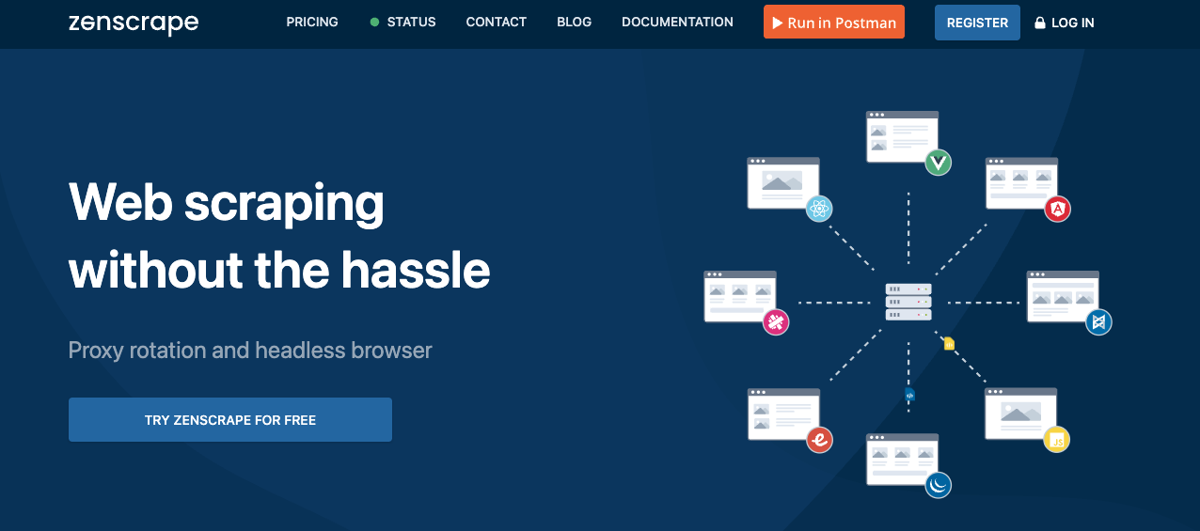
Zenscrape provides a developer-focused scraping API designed to handle dynamic, JavaScript-heavy content through headless browser rendering. The platform's architecture supports concurrent requests, making it a practical option for small-to-mid-scale scraping without the complexity of enterprise platforms. It includes a request builder that generates production-ready code snippets from API parameters for several programming languages, including Python and Node.js.
Pricing model: Free plan is available. Plans: Small ($59.99/month), Medium ($99.99/month), Large ($249.99/month), and Professional ($349.99/month).
10. WebScrapingAPI
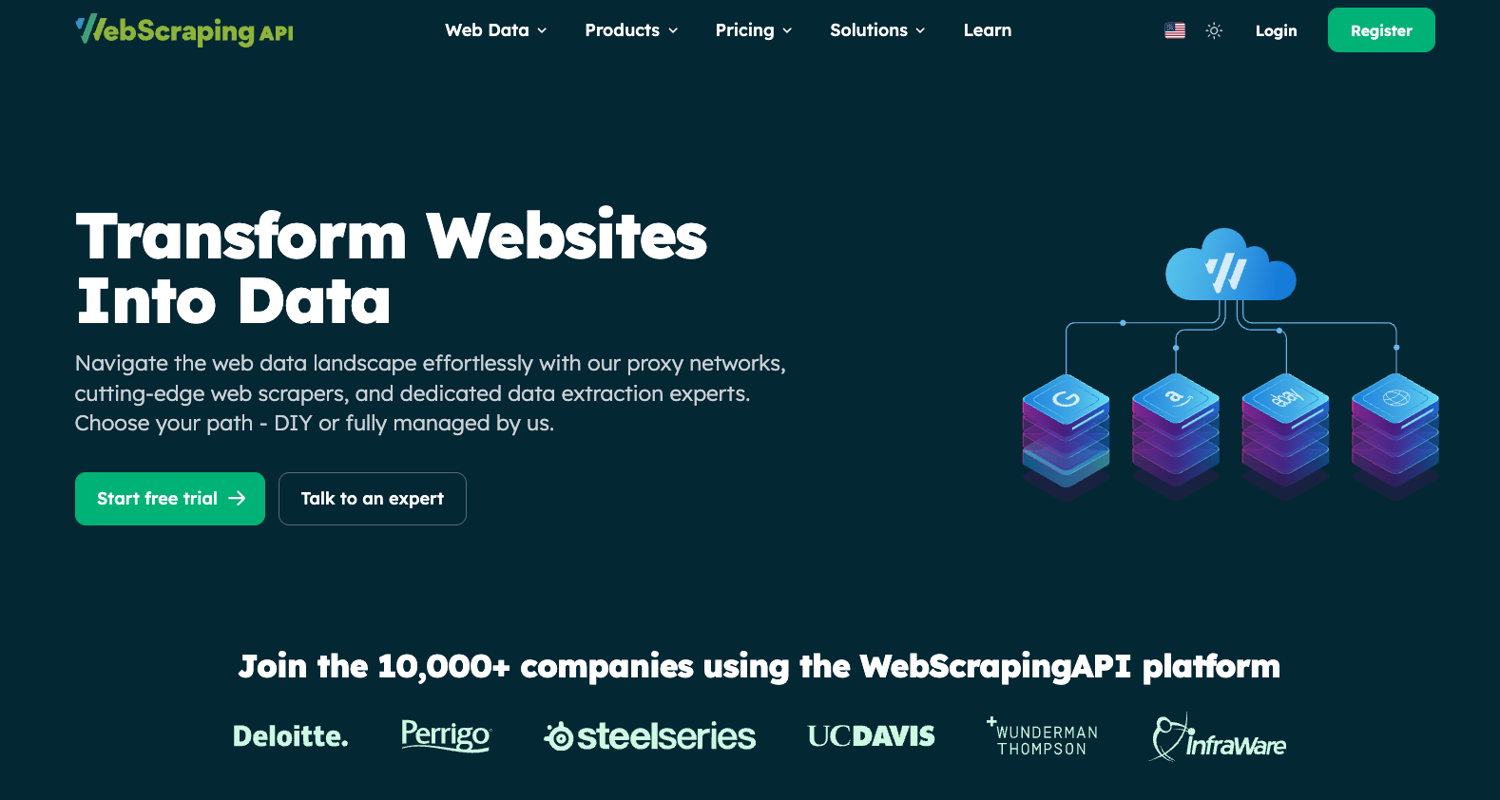
WebScrapingAPI is designed for fast setup and minimal configuration. It handles proxy rotation, JavaScript rendering, and basic anti-bot measures automatically, returning structured responses without infrastructure management.
Site-specific APIs for common targets like Google Search and Amazon reduce integration time for narrow use cases. Pricing separates general scraping from site-specific APIs, which can add up across multiple endpoints. For teams that want a drop-in API with a short path to working scraper, it's a practical starting point.
Pricing model: Free trial available. Starter ($19/month), Basic ($49/month), Standard ($99/month), Advanced ($149/month), Premium ($249/month), Pro ($599/month).
What Are JavaScript-Rendered Websites?
A JavaScript-rendered website is one where the browser, rather than the server, generates the visible content. When a React, Angular, or Vue application is loaded, the server sends a minimal HTML shell and a JavaScript bundle. The browser then executes that script, makes API calls, and populates the DOM.
A traditional HTTP request only fetches the initial shell, often returning an empty page. This is known as Client-Side Rendering (CSR). Most modern SaaS products and dynamic e-commerce sites use CSR, which necessitates a scraper capable of scraping JavaScript web pages by executing the scripts before the data is read. Best web scraping JavaScript workflows require a tool that can handle scraping JavaScript web pages by actually executing the JavaScript before reading the page.
Why You Need a JavaScript-Friendly Scraper
The challenges go beyond rendering. Modern JavaScript-heavy sites use AJAX calls that load content in batches, infinite scroll that only fetches data as you move down the page, and dynamic DOM updates that change structure after load.
Anti-bot systems add another layer: they inspect browser fingerprints, TLS signatures, request timing, and behavioral patterns. The best JavaScript web scraping solutions handle all of this automatically, and if you're building your own pipeline, understanding web scraping with Node.js is a solid starting point for best web scraping with JavaScript at the infrastructure level.
How to Choose the Best JavaScript Scraper
Choosing the best JavaScript web scraper comes down to a practical checklist. Work through these questions before evaluating any tool. Cross-reference independent benchmarks and official documentation alongside vendor claims. G2 reviews and published GDPR compliance documentation are useful signals for the best API for JavaScript and the best JavaScript API framework decisions.
- JS execution support: Confirm it runs a real headless browser, not a basic HTTP client.
- Proxy rotation: Verify the service provides automatic residential proxy rotation.
- CAPTCHA solving: Check whether solving is automatic and how it handles advanced challenges like Cloudflare Turnstile.
- API response speed: Benchmark against your target sites before committing. Rendering adds latency.
- Pricing model: Confirm whether you're billed per request, per successful request, or per credit.
- Rate limits: Check concurrency limits. Low limits will bottleneck high-volume pipelines.
- Compliance and security: For enterprise use, look for published GDPR documentation and transparent proxy sourcing.
Start Scraping JS-Rendered Sites with ScrapingBee Today
For developers who need a reliable solution for best JavaScript web scraping without managing browser infrastructure, ScrapingBee is the most practical starting point. It handles JS rendering, proxy rotation, and anti-bot bypass through a simple REST API, the best JavaScript API for teams that want to go from zero to working scraper without DevOps overhead. Sign up today and get free credits to test it against your target sites before committing.
Best JavaScript Scraping Tool FAQs
What is the best JavaScript web scraper for dynamic websites?
ScrapingBee is the strongest option for most use cases: it handles JavaScript rendering, proxy rotation, and anti-bot bypass via a simple REST API. For custom automation workflows, Apify's actor-based platform is worth evaluating.
How do APIs handle JavaScript-rendered content?
They spin up a headless browser instance, load the target page, wait for JavaScript to execute and the DOM to populate, then return the rendered HTML. Some APIs expose controls to customize how long to wait and what to interact with before returning data.
Can I scrape React or Angular websites with an API?
Yes. Any API on this list with JS rendering support can scrape React and Angular sites. The key is ensuring the API waits for dynamic content to load before capturing the page, not all tools handle deferred rendering the same way.
Do JavaScript scraping APIs bypass CAPTCHAs automatically?
Most do, though the coverage varies. ScrapingBee, Bright Data, and Oxylabs handle most CAPTCHA types automatically. More advanced challenges like Cloudflare Turnstile may require additional configuration or a premium plan.
Is Node.js required for web scraping with JavaScript?
No. The APIs in this guide work via HTTP requests, so you can use any language, Python, Ruby, Go, or Node.js. Node.js is a popular choice for scraping workflows because it shares a language with browser JavaScript, but it is not a requirement.
What's the difference between a scraping API and a headless browser?
A headless browser is a browser that runs without a graphical interface, like Chrome in headless mode. A scraping API is a managed service that runs headless browsers on your behalf and exposes the results via HTTP.

Jakub is a Senior Content Manager at ScrapingBee, a T-shaped content marketer deeply rooted in the IT and SaaS industry.