Amazon runs its own anti-bot infrastructure at scale and updates it continuously, which means proxies that worked last quarter may already be flagged.
This guide ranks the best proxies for Amazon scraping in 2026 across residential, ISP, and mobile pools, with honest notes on which proxy types work for different Amazon workloads and when managed APIs become the more cost-effective option.
Key Takeaways
- Oxylabs is the top-rated enterprise provider for Amazon scraping, ranking #1 for residential-proxy success in Proxyway's 2026 Amazon proxy benchmark.
- Residential proxies are essential for bypassing Amazon's ASN-level blocks that instantly flag and ban datacenter IP ranges.
- ISP proxies (static residential) offer the best session stability for multi-page product data extraction and account management.
- ScrapingBee provides a managed alternative that handles proxy rotation and anti-bot challenges automatically through a single API endpoint.
Quick Overview: Best Amazon Proxy Providers in 2026
- Oxylabs - Best overall for enterprise-scale Amazon scraping
- Bright Data - Best residential proxy pool with advanced targeting
- Decodo - Best value for mid-size scraping projects
- IPRoyal - Best budget entry point for small-volume jobs
- Webshare - Best static residential (ISP) proxies for stable sessions
- NodeMaven - Best for multi-account and high-performance use cases
- MarsProxies - Best affordable ISP and residential mix for tight budgets
The 7 Best Proxy Providers for Amazon in 2026
| Provider | Amazon Success (indicative) | Pricing |
|---|---|---|
| Oxylabs | 95.76% | Residential from $2.50/GB, ISP from $1.20/IP, datacenter from $0.70/IP, mobile from $3.50/GB |
| Bright Data | 96.75% | Residential from $2.50/GB, datacenter from $0.90/IP, ISP from $1.30/IP |
| Decodo | 95.65% | Residential from $2/GB, ISP from $0.27/IP, datacenter from $0.02/IP, mobile from $2.25/GB |
| IPRoyal | ~70%-99% | Residential from $1.75/GB, ISP from $1.80/proxy, datacenter from $1.39/proxy, mobile from $10.11/day |
| Webshare | 95.63% | ISP (static residential) from $0.30/IP, datacenter available, free datacenter plan |
| NodeMaven | 96.22% | Residential from $2.20/GB, ISP from $2.99/IP, mobile from $2.20/GB |
| MarsProxies | ~95% (self-reported) | Residential from $1.65/GB, ISP from $1.35/proxy, datacenter from $0.89/proxy, mobile from $2.83/day |
Success rates are indicative, drawn from provider-reported figures and third-party benchmarks (such as Proxyway). Real-world results vary by workload, target page, and configuration, so treat these as directional, not guarantees.
1. Oxylabs - Best Overall for Enterprise Amazon Scraping
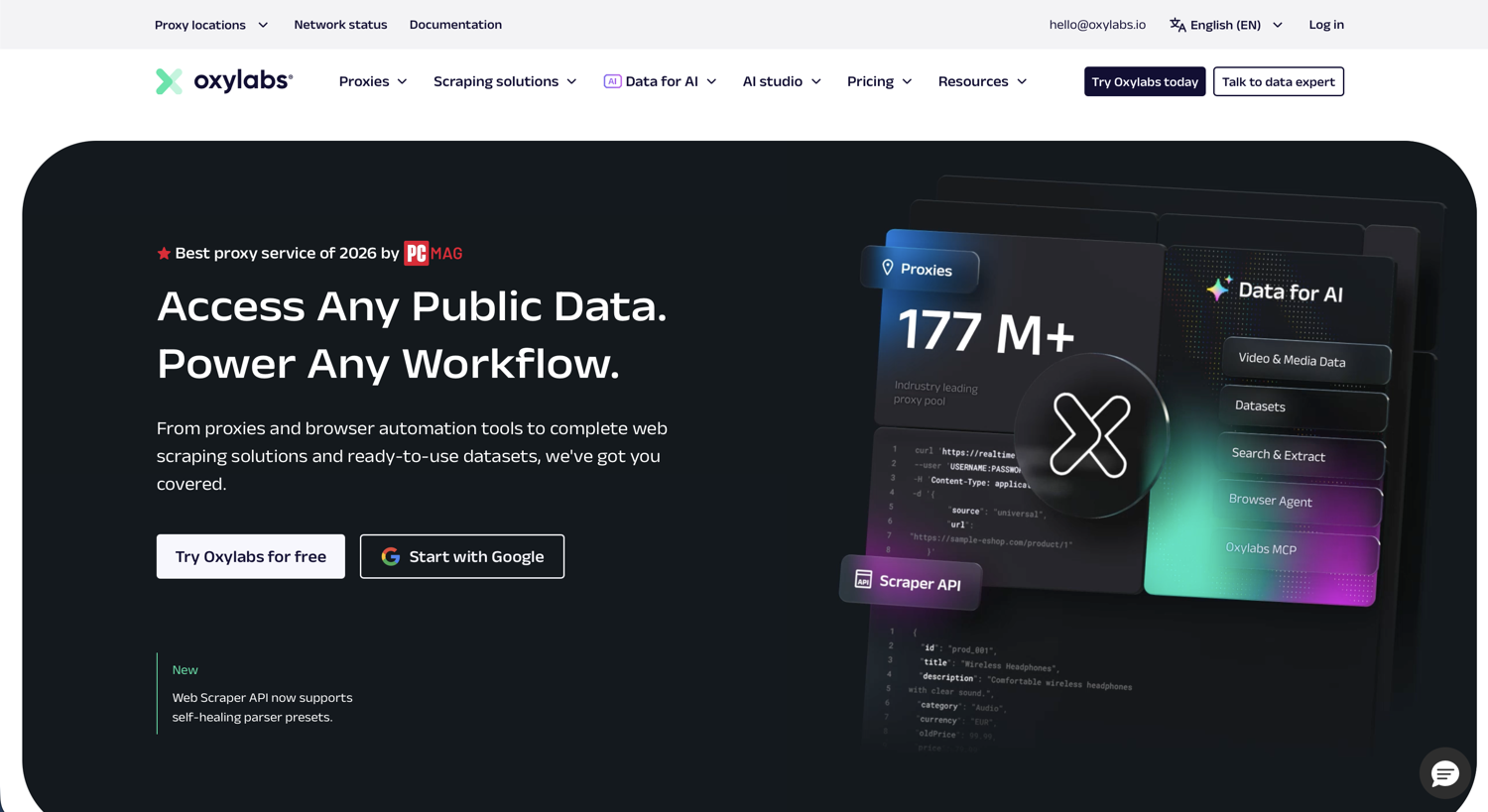
Oxylabs earns the top spot in enterprise infrastructure for its pool size and reliability. It provides over 175 million residential IPs, which supports high-volume scraping without hitting rate limits.
Proxyway's 2026 Amazon proxy benchmark measured Oxylabs' residential proxies at 95.76% on Amazon — the top result in the test. Its network is a common reference point for rotating and residential proxies in web scraping because it closely mimics organic user behavior.
- Pool Size: 175M+ Residential IPs
- Proxy Type: Residential, ISP, Datacenter, and Mobile
- Amazon Success: 95.76% (Proxyway benchmark)
- Pricing Model: Residential from $2.50/GB, ISP from $1.20/IP, datacenter from $0.70/IP, mobile from $3.50/GB. Verify current pricing on the provider's site; prices are subject to change.
- Sticky Sessions: Supported
- Limitation: The enterprise-first focus means pricing and technical support are optimized for high-spend clients, making it a "heavy" solution for solo developers.
2. Bright Data - Best Residential Pool with Advanced Geo-Targeting
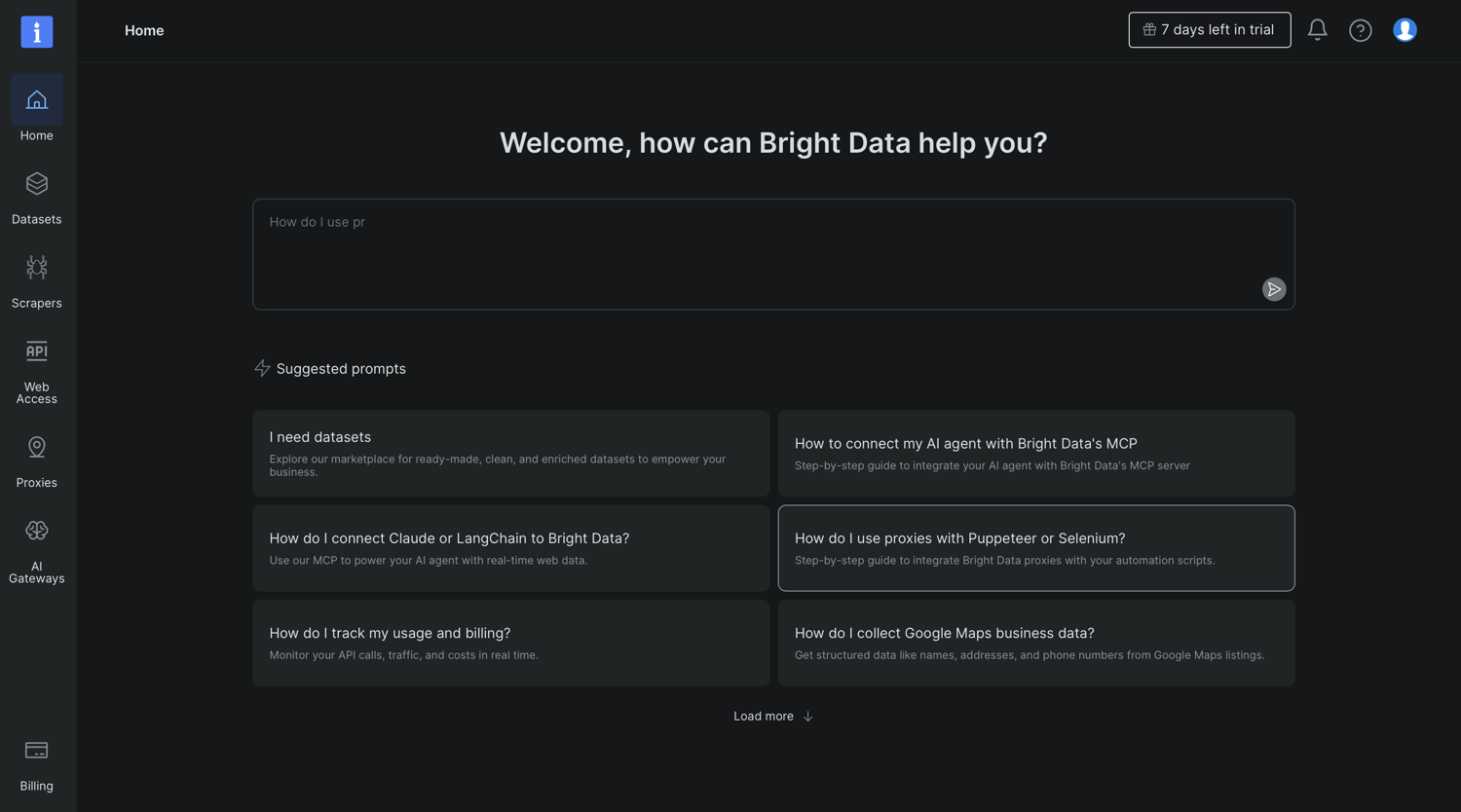
Bright Data stands out for advanced proxy configuration. Its platform offers real-time visibility and the ability to target a specific city or ZIP code, which matters when product listings vary by location. With 400M+ residential IPs across 195 countries, it is the largest pool on this list for avoiding IP reuse on high-frequency Amazon scraping runs.
- Pool Size: 400M+ Residential IPs
- Proxy Type: Residential, ISP, and Datacenter
- Amazon Success: 96.75% (Proxyway's test)
- Pricing Model: Residential from $2.50/GB, datacenter from $0.90/IP, ISP from $1.30/IP. Verify current pricing on the provider's site; prices are subject to change.
- Sticky Sessions: Highly customizable via its Proxy Manager
- Limitation: The depth of customization comes with a steep learning curve for new clients.
3. Decodo (formerly Smartproxy) - Best Value for Mid-Size Projects
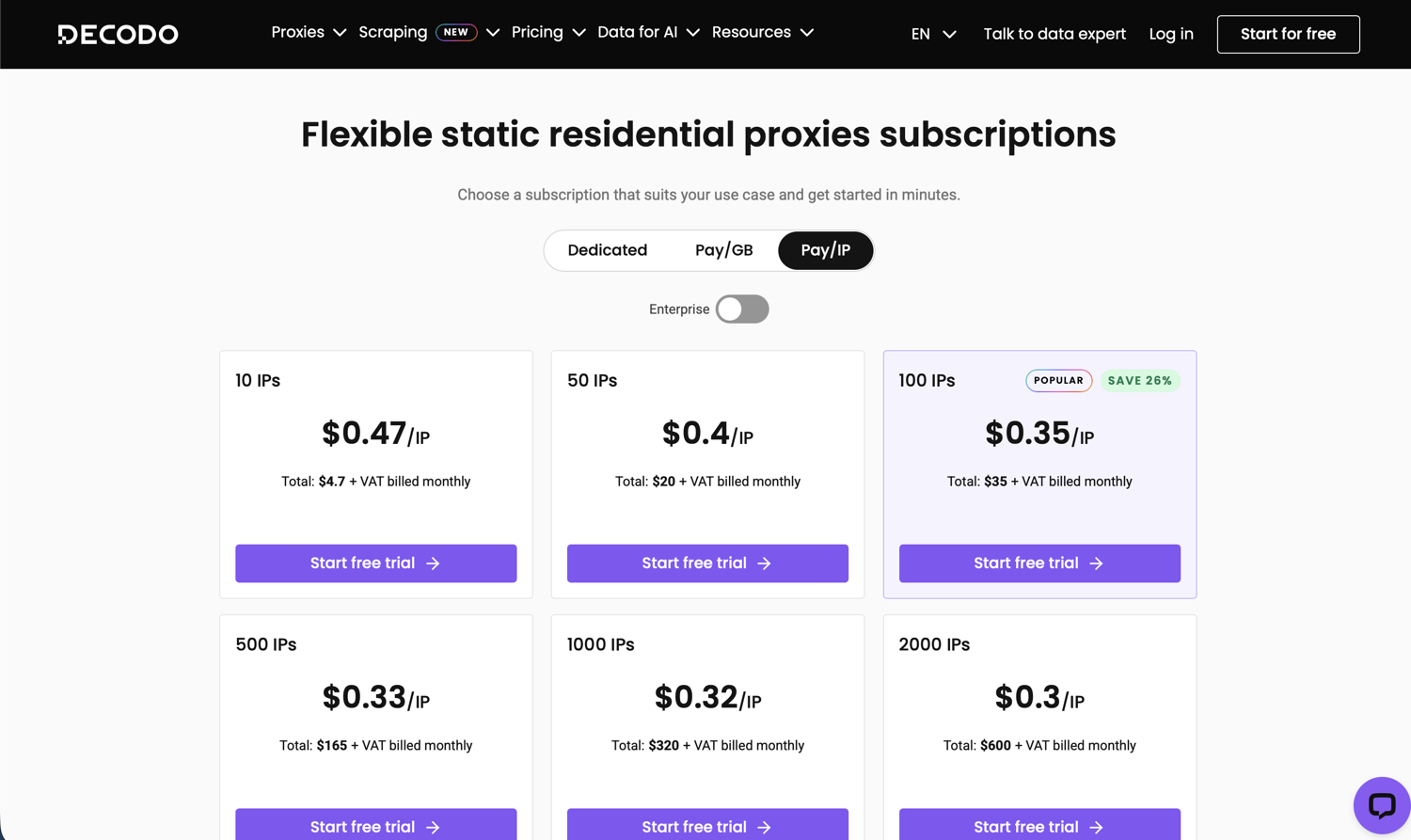
Decodo (formerly Smartproxy) offers the best balance of cost and reliable success. It provides straightforward integration and posts a 95.65% success rate in 2026 tests, which makes it a strong choice for developers who need to collect data without enterprise bloat. Developers looking to implement these proxies quickly can reference our list of the best Amazon scraping tools for pre-built code snippets.
- Pool Size: 115M+ Residential IPs
- Proxy Type: Residential, ISP, Datacenter, and Mobile
- Amazon Success: ~99% (provider-reported)
- Pricing Model: Residential from $2/GB, ISP from $0.27/IP, datacenter from $0.02/IP, mobile from $2.25/GB. Verify current pricing on the provider's site; prices are subject to change.
- Sticky Sessions: Supported with easy rotation toggles
- Limitation: Its dedicated ISP pool is smaller than enterprise leaders, which can increase IP reuse on long sessions.
4. IPRoyal - Best Budget Option for Low-Volume Scraping
IPRoyal is the pick for small-volume data needs. As a transparent proxy seller with ethically sourced IPs, it offers a reliable entry point for teams that don't want to manage a large proxy service contract.
- Pool Size: 64M+ Residential IPs
- Proxy Type: Residential, ISP, Mobile, and Datacenter
- Amazon Success: ~70%-99% (varies by configuration)
- Pricing Model: Residential from $7/GB, ISP from $1.80/proxy, datacenter from $1.39/proxy, mobile from $10.11/day. Verify current pricing on the provider's site; prices are subject to change.
- Sticky Sessions: Available for residential and ISP IPs
- Limitation: Median latency is higher than high-tier enterprise infrastructure.
5. Webshare - Best ISP Proxies for Stable, Long Sessions
Webshare is the pick for affordable static residential IPs. Its ISP proxies are sourced from major US carriers like Comcast and AT&T, billed per IP with up to unlimited bandwidth rather than per GB, which makes them well suited to multi-page crawling and sessions that need to hold the same IP through checkout or a product-to-reviews flow.
- Pool Size: 100K+ static residential (ISP) IPs
- Proxy Type: ISP (static residential), datacenter, residential, mobile
- Amazon Success: ~97% (indicative, static ISP sessions)
- Pricing Model: ISP (static residential) from $0.30/IP monthly with up to unlimited bandwidth; a free plan offers 10 datacenter proxies and 1GB/month. Verify current pricing on the provider's site; prices are subject to change.
- Sticky Sessions: Excellent, since static IPs don't rotate
- Limitation: The static residential pool is smaller and built on US carriers.
6. NodeMaven - Best for Multi-Account and High-Performance Jobs
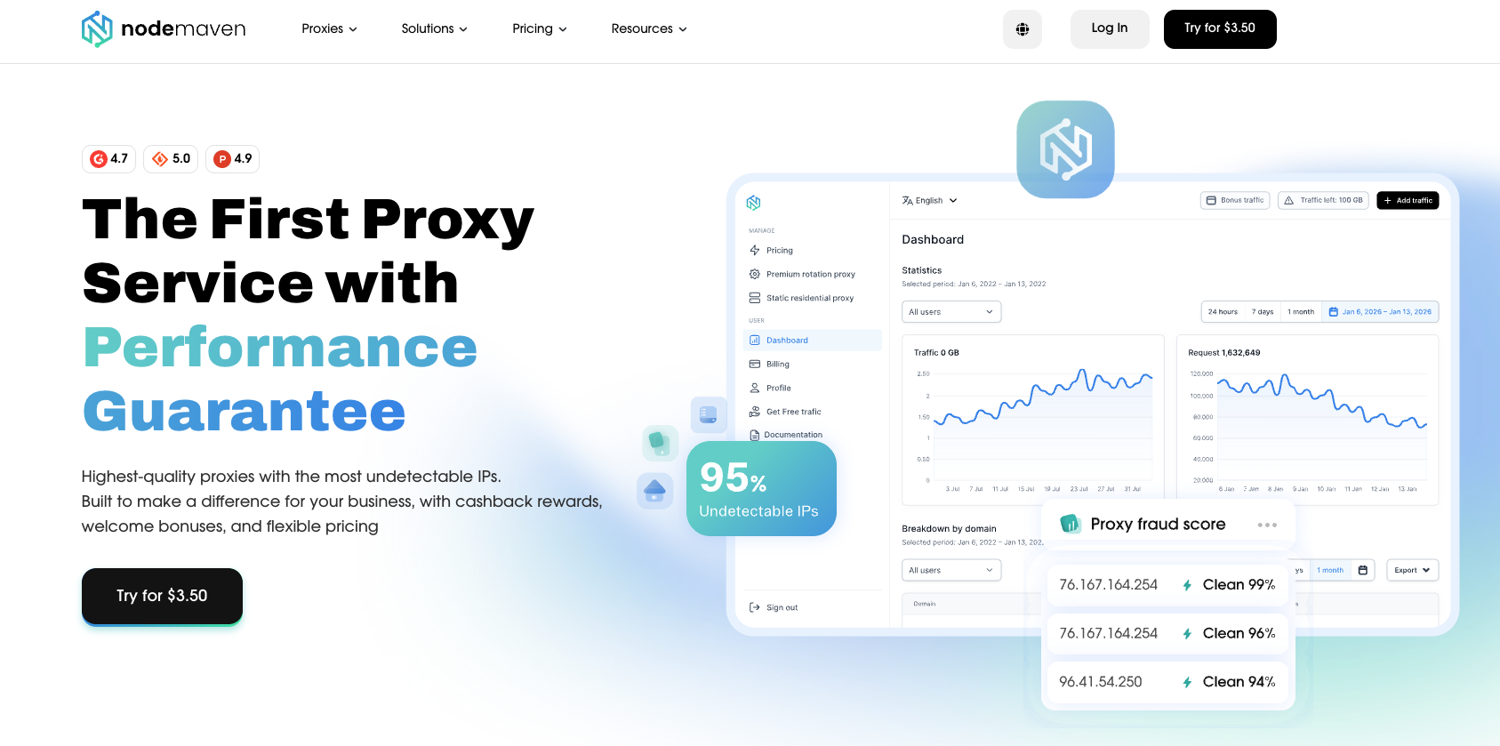
NodeMaven stands out for IP quality. Its system filters out suspicious IPs so you only use high-reputation addresses, which is critical for avoiding bans and account suspensions when managing multiple accounts. For Amazon workflows that need mobile carrier IPs, the best mobile and 4G proxy providers apply the same trust-score logic NodeMaven uses across its unified residential and mobile pool.
- Pool Size: 30M+ Residential IPs
- Proxy Type: Residential, ISP, Mobile
- Amazon Success: 96.22% (Proxyway's test)
- Pricing Model: Residential from $2.20/GB, ISP from $2.99/IP, mobile from $2.20/GB. Verify current pricing on the provider's site; prices are subject to change.
- Sticky Sessions: Built-in persistence for sensitive account tasks
- Limitation: The total IP count is lower because it prioritizes quality over raw quantity.
7. MarsProxies - Best Affordable Mix of Residential and ISP Proxies
MarsProxies is the pick for developers on a tight budget who still need rotating proxies. It offers solid proxy-type variety and reliable performance at some of the lowest prices in the industry.
- Pool Size: 1M+ Residential IPs
- Proxy Type: Residential, ISP, Datacenter, and Mobile
- Amazon Success: ~95%
- Pricing Model: Residential from $1.65/GB, ISP from $1.35/proxy, datacenter from $0.89/proxy, mobile from $2.83/day. Verify current pricing on the provider's site; prices are subject to change.
- Sticky Sessions: Basic support for rotating and static IPs
- Limitation: Its support team and technical documentation are more limited than premium competitors.
While these providers offer strong proxy infrastructure for Amazon, teams that want to skip the engineering overhead of managing rotation, retries, and anti-bot challenges should consider a managed scraping API like ScrapingBee as an alternative approach.
Why Amazon Is So Hard to Scrape (And What That Means for Proxy Choice)
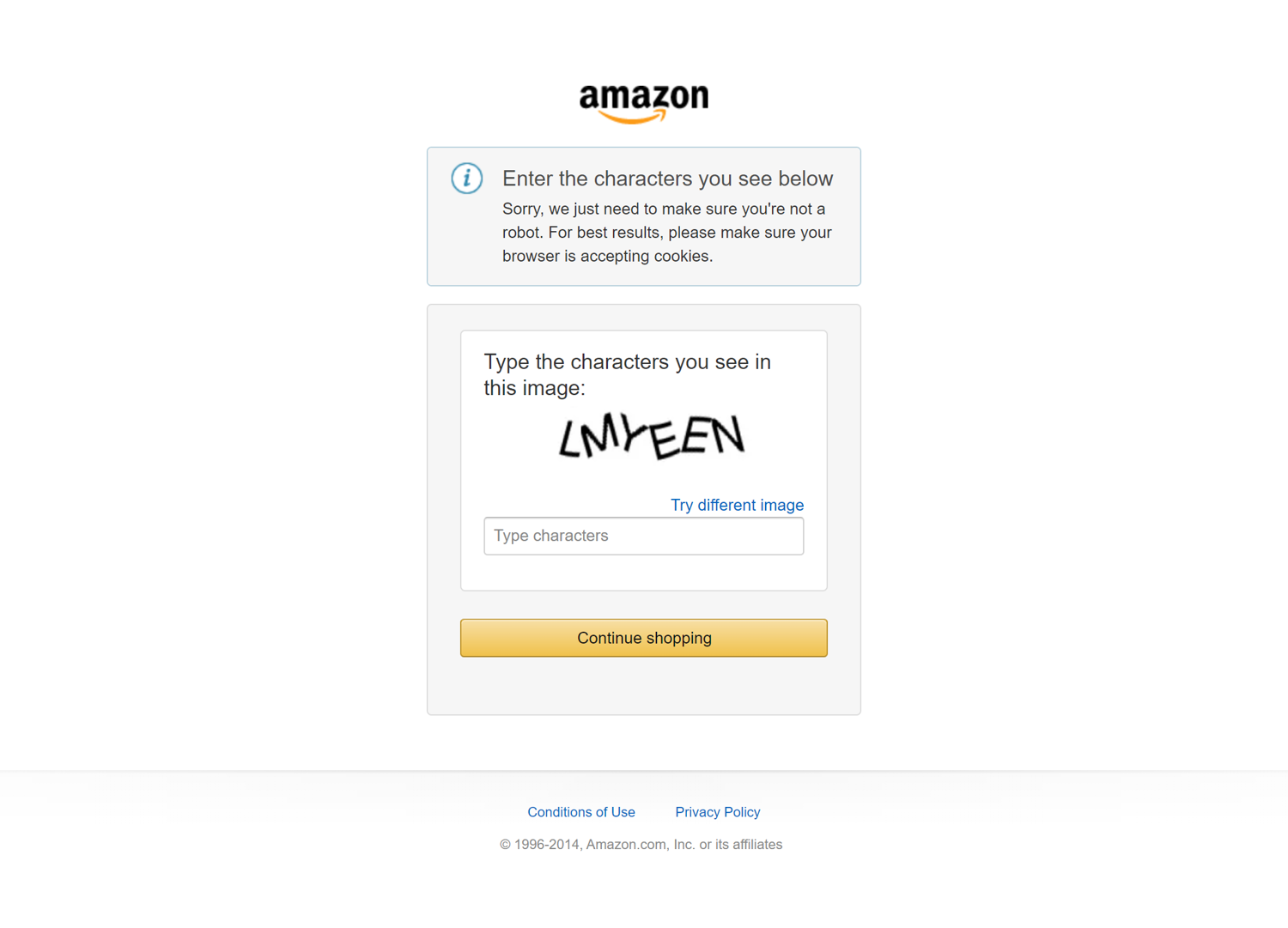
Amazon is a pioneer in anti-bot technology, deploying multiple defensive layers that make basic scraping techniques obsolete. The first barrier is ASN-level blocking: Amazon identifies and rejects entire IP ranges belonging to cloud providers, which is the primary reason residential proxies or ISP proxies are non-negotiable for this target.
Beyond IP reputation, Amazon uses browser fingerprinting, TLS fingerprinting, and behavioral analysis. Even with a premium IP, a request can be flagged if your headers don't rotate correctly or if your TLS handshake looks like a script rather than a browser. Amazon's localized domains (.com, .ca, .de) also geo-restrict product data, so you need proxies with precise geographic targeting to keep data accurate.
Managing these blocks has a direct financial impact. On Amazon, retry overhead is a high hidden cost. If your proxy pool has a 20-30% failure rate, your per-GB residential proxy spend climbs by roughly 25-45%, since you pay for the bandwidth of failed requests. (At a 50% failure rate, it effectively doubles.) Understanding this matters when you compare providers on real per-success cost, not just the headline per-GB rate.
Residential vs. Datacenter vs. ISP Proxies: Which Works Best on Amazon?
- Residential Proxies: The gold standard for Amazon. Since they use real consumer IPs, they are the hardest to detect, but usually the most expensive.
- ISP Proxies: A strong hybrid that offers datacenter-level speed with the high trust score of a residential IP. They are ideal for maintaining stable sessions.
- Datacenter Proxies: Generally ineffective. Amazon blocks most datacenter ASNs by default, so unless you're using free proxy lists for very low-stakes testing, they lead to immediate bans.
What to Look for When Choosing an Amazon Proxy Provider
Choosing a provider means matching its infrastructure to your extraction requirements. Use this framework to evaluate your options.
- Pool Size and Diversity: Amazon rotates detection patterns aggressively. A provider with a large residential pool lowers IP reuse frequency, which is the most effective way to reduce ban rates on long-running jobs.
- Sticky Session Support: This is critical for multi-page flows, such as navigating from a product detail page to its reviews. Session drops mid-sequence often trigger re-authentication or CAPTCHAs, stalling your pipeline.
- IP Sourcing and Legitimacy: Choose providers with transparent, consensual IP sourcing. This isn't only an ethics point: on July 2, 2026, the FBI and Google seized NetNut's domains (NetNut is operated by Alarum Technologies) after Google linked the associated Popa botnet to roughly two million hijacked consumer devices. A provider's sourcing practices directly affect whether it will still be online next quarter.
- Pricing Model Alignment: Per-GB pricing is ideal for low-volume tasks with high success rates. However, for high-retry workflows, bandwidth costs can explode. In those cases, the 'per-request' model used by web unblocker tools is often more predictable.
- Geo-targeting Granularity: Amazon localizes stock and pricing, so the ability to target specific regions or country domains is essential for data accuracy. When evaluating price-monitoring scraping tools, make sure the underlying proxy infrastructure supports city-level or ZIP-code targeting to capture regional price variations correctly.
Are Free Amazon Proxies Worth Using?
Free proxies are almost universally blacklisted by Amazon. Because these IPs are shared across thousands of users simultaneously, they get flagged and banned within minutes of appearing online. The true "cost" of free proxies is the engineering debt: hours spent debugging failed requests, rotating dead IPs manually, and rebuilding scrapers after a total ban.
For any production-scale Amazon project, paid residential or ISP proxies are the minimum viable starting point. While you can find a free AI-powered proxy scraper to source public proxies for low-stakes testing, reliable data extraction requires the premium infrastructure mentioned in our top picks.
Skip Proxy Management Entirely with a Scraping API
Managing a raw proxy pool for Amazon is a full-time engineering commitment. For teams that want to avoid the overhead of building rotation logic and CAPTCHA-solving layers, a managed web scraping API like ScrapingBee offers a legitimate alternative. Instead of maintaining complex infrastructure, developers make a single API call; the service handles proxy rotation, header management, and automatic retries internally.
While raw proxy providers are the right choice for teams requiring total infrastructure control, ScrapingBee is built for those who want to focus on data, not maintenance. For Amazon scraping at scale, the total cost of an API is often comparable to or lower than per-GB residential proxy costs when you factor in the bandwidth wasted on failed requests. If you are currently evaluating the 5 best AI web scraping tools in 2026, you'll find that ScrapingBee provides the underlying reliability needed to feed those tools clean, rendered data without the need for manual proxy tuning.
Focus on Data, Not Proxy Management
Managing proxies for Amazon is a real engineering drain. Between maintaining rotation logic and absorbing the cost of failed retries, the infrastructure often becomes more expensive than the data it collects. Amazon's frequent detection updates mean a setup that works today might fail tomorrow.
ScrapingBee removes this complexity by handling proxy rotation, anti-bot challenges, and JavaScript rendering through a single API call.
Sign up today and get 1,000 free credits, skip the complex infrastructure, and focus on what matters most.
Amazon Proxy FAQs
How do you trick Amazon location?
To work around localized restrictions, use a residential proxy with geo-targeting set to the specific country or city you want Amazon to detect. Residential IPs are the most reliable method because they come from real consumer connections in that region, rather than VPN endpoints that Amazon recognizes and blocks. Most premium providers support both country and city-level targeting.
What are the best proxies to use for Amazon?
Residential proxies are the best choice for Amazon because they use real consumer IP addresses that Amazon can't block at the ASN level. ISP proxies (static residential) are a strong alternative when you need consistent session stability for multi-page crawling without the higher cost of rotating residential pools.
Is IPRoyal legal?
IPRoyal is a legitimate registered company operating a legal proxy service. Using it to collect publicly available data is generally legal in most jurisdictions, though legality depends on your specific use case. Scraping public Amazon data is usually a contractual matter tied to Terms of Service rather than a criminal violation. Always consult legal counsel.
Are proxy servers illegal?
Proxy servers are legal in most countries and are widely used by businesses for privacy, security, and data collection. Using proxies to scrape publicly available data is generally legal, though it may conflict with a website's Terms of Service. Always review the target site's ToS before starting a high-volume scraping project.
Can I use AWS as a residential proxy for Amazon scraping?
No. AWS IP ranges are well-known datacenter addresses that Amazon identifies and blocks almost immediately, so they don't function as residential proxies. For successful Amazon scraping, use proxies from a dedicated residential proxy provider that offers IPs registered to real consumer internet service providers, not cloud hosting IPs.

Jakub is a Senior Content Manager at ScrapingBee, a T-shaped content marketer deeply rooted in the IT and SaaS industry.