Building location-based services often reveals the frustration of hitting rigid quotas. Developers quickly learn that while the official Google Places API is a starting point, costs can escalate rapidly. Vendor lock-in is a significant risk in 2026, where high costs and restrictive licensing can hinder product scalability.
Fortunately, the landscape has shifted. Whether a structured dataset or large-scale public data extraction is needed, there's a Google Places API alternative for every use case. This guide meticulously compares top Google Places API options, evaluating both official licensed providers and flexible scraping engines, to help you build faster and more cost-effectively.
Quick Answer: What is the Best Places API?
The best places api depends entirely on your technical requirements. It also depends on how you plan to use the data. If you need a simple experience with licensed datasets, an official places api like Foursquare or LocationIQ is your best bet. These are excellent for standard geocoding and finding points of interest.
However, some users need massive scale. They might need specific data points that official APIs hide. In these cases, a Google Places API alternative based on scraping is often better. Solutions like ScrapingBee provide the infrastructure to extract publicly available data. This includes proxy rotation and headless browsers. This approach avoids the overhead of enterprise licenses.
Typically, startups often prefer the flexibility of scraping for lead generation. Established apps often stick to structured APIs for real-time navigation features. We will look at both categories in this guide.
Shortlist
Here is a quick look at the top google places api contenders for 2026.
| Provider | Type | Best For | Pros & Cons | Pricing (x/month) | JS Rendering | Proxy Management | Scalability |
|---|---|---|---|---|---|---|---|
| Foursquare | Official API | Enterprise POI data | Pro: Deep metadata. Con: High cost. | Usage-based | N/A | Included | High |
| Geocode Earth | Official API | Clean OSM data | Pro: No derived data terms. Con: Lower POI density. | Subscription | N/A | Included | Medium |
| ScrapingBee | Scraping Engine | Custom extraction | Pro: Bypasses anti-bots. Con: Requires parsing. | From $19/mo | Yes | Yes | Very High |
| LocationIQ | Official API | Budget-friendly | Pro: Affordable. Con: Data freshness varies. | From $49/mo | N/A | Included | Medium |
| ArcGIS | Official API | GIS Analytics | Pro: Powerful tools. Con: Complex pricing. | Custom | N/A | Included | High |
Top Google Places API Replacements
Let's break these down into two main categories. We will look at direct APIs first. Then we will look at scraping-based solutions. Each has different trade-offs regarding cost and coverage.
Direct Alternatives
These providers offer licensed and structured datasets. They are clean but often come with stricter usage terms.
1. Foursquare Places API
Foursquare is a powerhouse for point-of-interest data. The global coverage is impressive. It is a strong best places api if you need rich metadata like photos and reviews.
- Best for: Enterprise retail analytics and geographic applications.
- Pros: It has deep data richness and high accuracy in urban areas.
- Cons: It can become expensive at high volumes and has strict attribution rules.
- Pricing: Usage-based pricing models are typical.
2. Geocode Earth
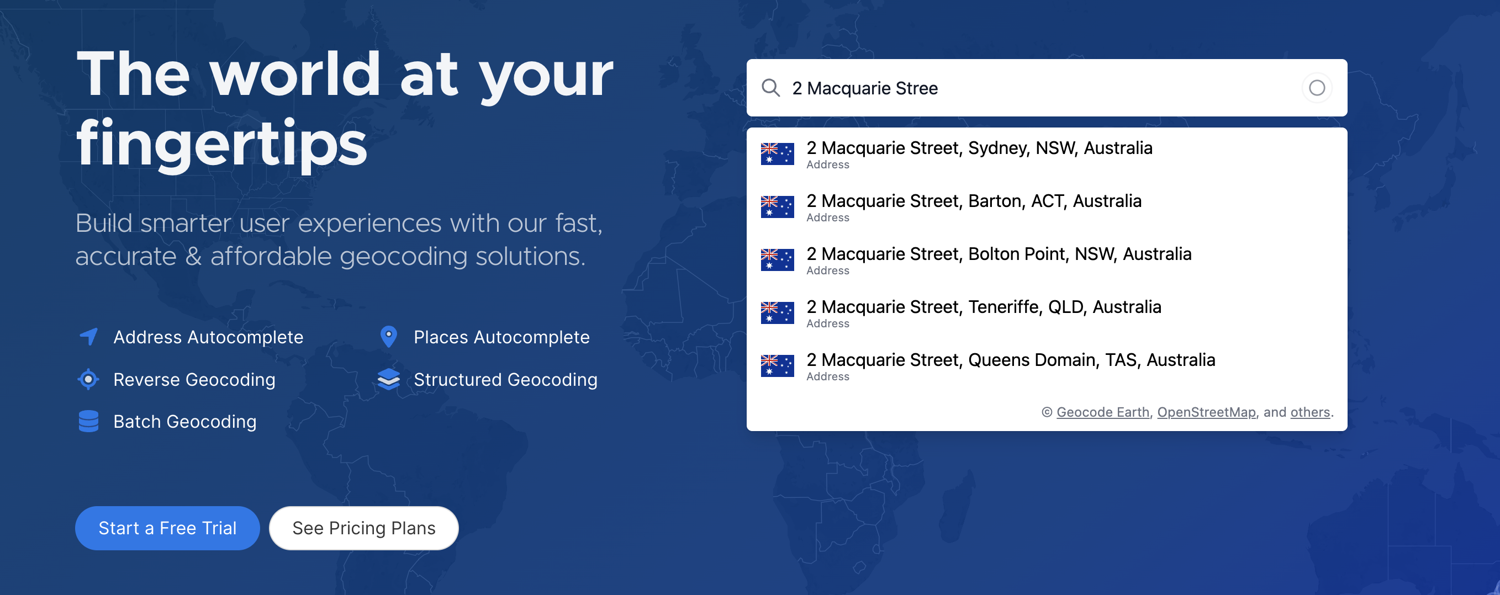
Geocode Earth is a great Google Places API alternative for those who value OpenStreetMap data. It is very developer-friendly. They focus heavily on clean geocoding and search. I found their documentation very clear during my testing.
- Best for: Developers wanting a simple and transparent solution.
- Pros: There are no restrictive derived data terms.
- Cons: Point of interest density can be lower than proprietary sets in some regions.
- Pricing: Usually starts with subscription tiers.
3. ArcGIS
ArcGIS by Esri is more than just a places API; it is a full GIS suite. Its mapping and spatial analysis tools are widely regarded as world‑class, making it one of the strongest Google Places API alternatives for advanced spatial analysis.
- Best for: Enterprise-grade mapping tools and complex GIS capabilities.
- Pros: It offers powerful analytics and enterprise support.
- Cons: The pricing structure is notoriously complex for small teams.
- Pricing: Custom enterprise pricing or credits-based systems.
4. LocationIQ
LocationIQ is a top contender for the best places API on a budget. It uses OpenStreetMap data but provides a fast API layer. Its ease of integration makes it suitable for small projects.
- Best for: Affordable geocoding and point of interest lookups.
- Pros: It has a very generous free tier and is easy to use.
- Cons: Data freshness depends entirely on OpenStreetMap updates.
- Pricing: Paid plans are very affordable for startups.
5. MapKit JS - Apple
If you build for the Apple ecosystem, MapKit JS is a strong Google Places API alternative. It provides high-quality visual assets.
- Best for: Apps targeting iOS users or Apple-centric web apps.
- Pros: It is often included with a developer account up to certain limits.
- Cons: It is limited to the Apple ecosystem and has restrictive terms.
- Pricing: Included with the $99/year Apple Developer Program.
For Structured & Scraped Data Flexibility
Some businesses need more than an official API provides. This is where scraping engines come in. These tools are infrastructure. They allow you to extract large-scale data that official quotas might block. We only support extracting publicly available data.
6. ScrapingBee
Our solution functions as a backend scraping engine. We handle headless browsers and proxy rotation for you. We also manage JavaScript rendering and anti-bot bypass. We are not a licensed dataset provider. Instead, we provide the tools to build your own google places api alternative.
For example, a customer used our web scraping api to extract restaurant listings for lead generation. Because we handle the technical hurdles, they could focus on the data. We take compliance seriously and ensure our tools are used for public data in line with GDPR. You can even use ai web scraping to parse complex local listings into clean JSON automatically.
- Best for: Scalable extraction of public local business data and lead generation.
- Pros: It prevents you from getting blocked and handles complex sites.
- Cons: You must handle the parsing of raw HTML.
- Pricing: Starts at $19 per month.
7. Oxylabs
Oxylabs is a heavyweight in the proxy world. Their scraper APIs are built for massive enterprise scale.
- Best for: Large-scale data harvesting and market research.
- Pros: They have a massive proxy pool and high reliability.
- Cons: The pricing is at a premium and may be overkill for small tasks.
8. Bright Data
Bright Data offers a huge infrastructure for data collection. They provide a web scraper IDE that is quite powerful for custom logic.
- Best for: Companies needing end-to-end managed data collection.
- Pros: It is extremely flexible and feature-rich.
- Cons: There is a high learning curve and complex pricing.
9. Decodo
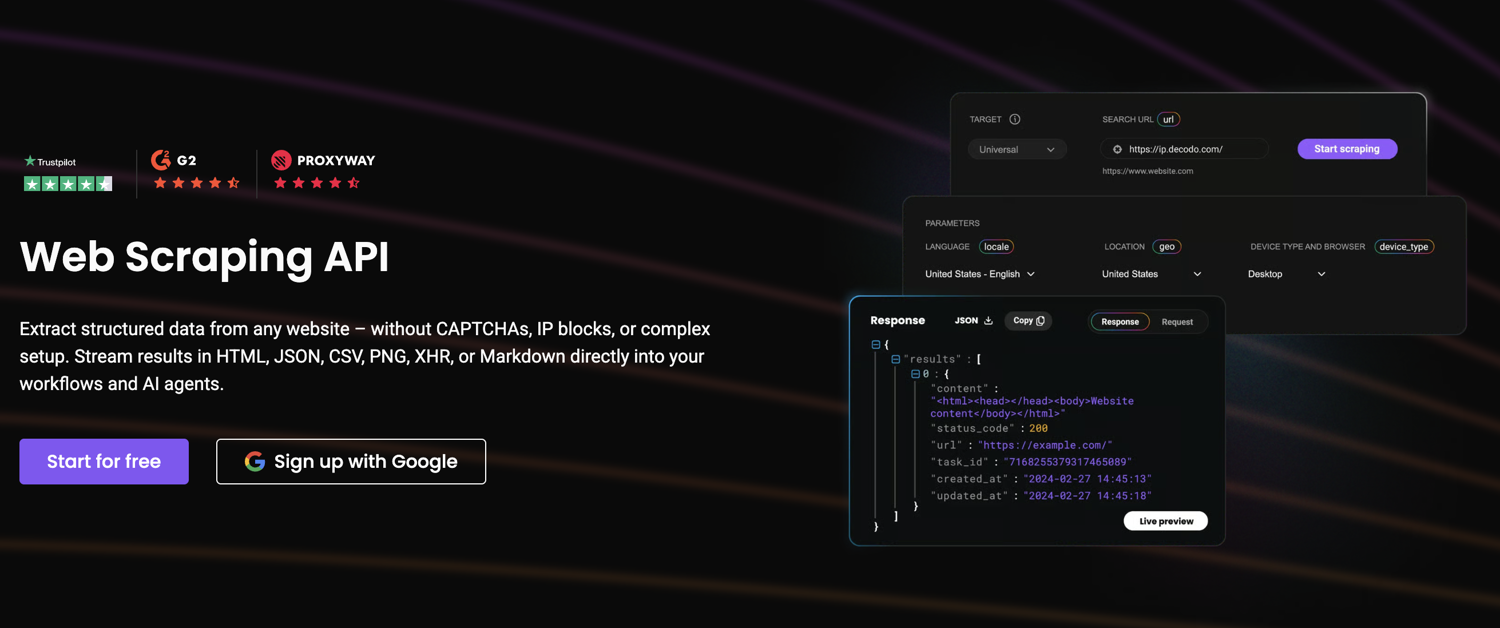
Decodo focuses on providing high-quality data through specialized scraping infrastructure.
- Best for: Targeted data extraction with a focus on accuracy.
- Pros: It offers a good balance of power and ease of use.
- Cons: It has a smaller brand presence compared to competitors.
10. Zyte
Zyte is a pioneer in the scraping space. Their API is designed to handle very difficult sites.
- Best for: Developers who need a robust and battle-tested middleware.
- Pros: They have excellent automatic extraction features.
- Cons: It can get expensive as you add advanced features.
How to Choose the Best Google Places API Alternative
Choosing a google places api alternative is about your long-term data strategy. I recommend using this decision framework:
- Data ownership: Do you need to store the data permanently?
- Licensing: Are you building a commercial app? Check the terms.
- Rate limits: How many requests per second do you need?
- Budget: What is your monthly limit for data?
- Compliance: Always ensure your methods respect GDPR.
- Technical complexity: Are you comfortable parsing HTML?
- JavaScript rendering: Does the source site require a real browser?
Decision Checklist
- I need real-time navigation. (Choose an Official API)
- I am building a database for market research. (Choose a Scraping Engine)
- My budget is under $100 per month. (Look at LocationIQ or ScrapingBee)
- The site uses heavy JavaScript. (Ensure your tool supports JS rendering)
If you need a Google Search API to supplement your Google Places data, that is another factor to consider.
Ready to Try Getting Google Places Data with ScrapingBee?
If you are tired of hitting walls with official quotas, it is time to try a more flexible approach. Our solution provides the reliable backend infrastructure you need to extract publicly available Google Places data. You can do this at scale without the headache of managing proxies. Whether you build a lead generation tool or a local directory, our web scraping API makes automation simple.
Sign up today and get free credits to start building your google places api alternative solution.
Places API FAQs
What is Google Places API?
It is a service that provides information about points of interest and geographic locations. It returns structured data like addresses and ratings through HTTP requests.
Is scraping Google Places legal?
Scraping publicly available data is generally legal based on various court rulings. However, you must comply with GDPR if you handle personal data. You should also avoid scraping behind login walls or causing technical harm to a site.
What Google Places data can be retrieved legally?
You can typically retrieve any data that is publicly visible to a user without an account. This includes business names, addresses, and public ratings.
What are the rate limits of the Google Places API?
The official API uses a pay-as-you-go model with specific queries per minute limits. If you exceed these, your requests will be capped unless you increase your budget.
Which is the best Google Places API alternative for startups?
For startups, I usually recommend LocationIQ for low costs or ScrapingBee for flexibility. These allow for growth without massive enterprise fees.
When should you use scraping instead of an official Places API?
You should use scraping when you need to store data long-term. It is also better when you need data points not provided by the official API or when costs become prohibitive at scale.

Karolis is Head of Growth at ScrapingBee. Previously built and scaled technology products in data and e-commerce verticals.